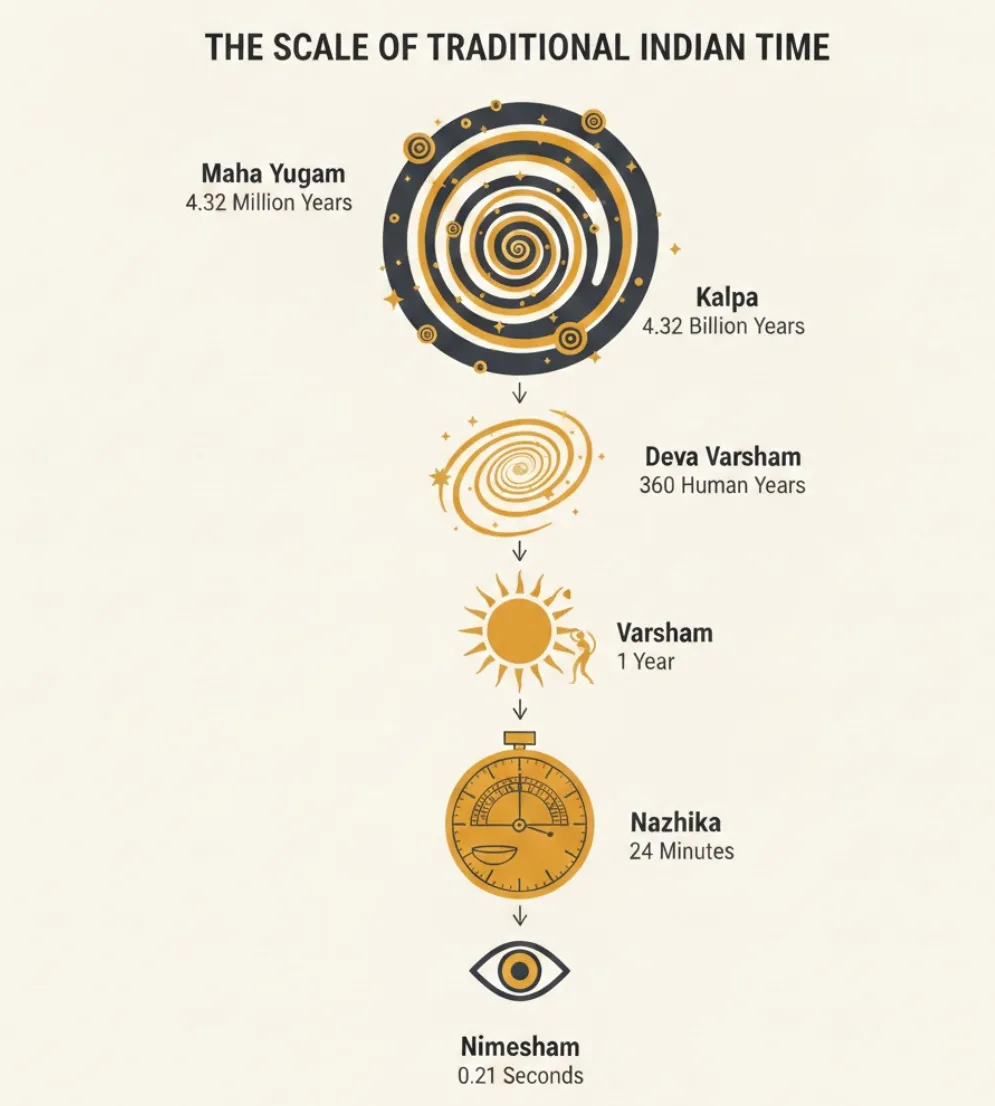
When we look at a digital clock, we see a linear progression of numbers. The Kerala School of Astronomy and Mathematics—one of the most influential scientific lineages in history—saw time differently: to them, time was a recursive, fractal loop.
Their system used a sexagesimal (base‑60) model. Much like the 360 degrees of a circle, base‑60 allowed precise divisions without many fractional residues. This post documents traditional Kerala time units and how they map from the human pulse to the rhythms of the sky.
Before we dive in, you can use the below calculator to map current time to the Kerala system.
The Kerala School and the Base-60 Logic
Between the 14th and 16th centuries, Kerala was a global hub for mathematical innovation. Figures like Madhava of Sangamagrama and Nilakantha Somayaji were refining infinite series and planetary models.
At the heart of their calculations was the Sexagesimal System. Why 60? Because 60 is a “superior highly composite number,” divisible by 1, 2, 3, 4, 5, 6, 10, 12, 15, 20, and 30. This mathematical flexibility allowed Kerala’s astronomers to sync the smallest unit of human life with the largest cycles of the cosmos.
The Biological Foundation: The Prana
Unlike the abstract “second,” the Kerala model begins with the body. The fundamental unit is the Prana (or Asu), the time taken for a healthy person at rest to complete one respiratory cycle.
Mathematically:
- 1 Prana ≈ 4 seconds
- 6 Pranas = 1 Vinazhika (24 seconds)
- 60 Vinazhika = 1 Nazhika (24 minutes)
This biological anchor means time is not external—it is literally the pace at which we live. A full day is composed of exactly 21,600 breaths.
Daily Units and the Ahorathram
In the Kerala model, a “day” is not a 24‑hour block starting at midnight. It is an Ahorathram, a 60‑Nazhika cycle starting at Sunrise (Udayam).
To manage daily life, the day is divided into 8 Yamams (watches). Each Yamam lasts 3 hours (7.5 Nazhikas). This structure dictated the shifts of traditional life—from temple rituals to Ayurvedic schedules.
The Eight Yamams (3‑Hour Watches)
| Yamam | Range (Nazhikas) | Modern Approx |
|---|---|---|
| 1st | 0–7.5 | 06:00–09:00 |
| 2nd | 7.5–15 | 09:00–12:00 |
| 3rd | 15–22.5 | 12:00–15:00 |
| 4th | 22.5–30 | 15:00–18:00 |
| 5th–8th | 30–60 | Night cycle |
Seasonal and Solar Rhythms: The Ritus
As we scale up, the system aligns with the Sun’s transit through the zodiac. A year is divided into six Ritus (seasons), each lasting two solar months. These seasons are ecological markers that dictate agriculture and diet:
- Vasanta (Spring): Meenam–Medam.
- Grishma (Summer): Edavam–Mithunam.
- Varsha (Monsoon): Karkidakam–Chingam.
- Sharad (Autumn): Kanni–Thulam.
- Hemanta (Pre‑winter): Vrischikam–Dhanu.
- Shishira (Winter): Makaram–Kumbham.
The Great Scaling: Into the Cosmic Cycles
This is where the sexagesimal model reaches its full scope. By multiplying units, mathematicians mapped vast epochs. One human year is a brief moment in the Deva Varsham (Divine Year). These aggregate into the Yuga cycles, eventually culminating in a Kalpa—a single “day” in the life of the cosmic creator, spanning 4.32 billion years.
Master Table: The Kerala Mathematical Hierarchy
| Category | Traditional Unit | Components / Equivalents | Modern Duration (Approx.) |
|---|---|---|---|
| Micro | Nimesham | Base unit (a blink) | 0.21 seconds |
| Vinazhika | 120 Nimeshams | 24 seconds | |
| Daily | Nazhika (Ghati) | 60 Vinazhika | 24 minutes |
| Muhurtham | 2 Nazhikas | 48 minutes | |
| Yaamam | 7.5 Nazhikas | 3 hours | |
| Ahorathram | 60 Nazhikas / 8 Yaamams | 24 hours (1 Day) | |
| Lunar | Tithi | separation of Sun & Moon | ~19 to 26 hours |
| Paksham | 15 Tithis (Fortnight) | ~14.75 days | |
| Maasam (Month) | 2 Pakshams | ~29.5 days | |
| Seasonal | Ritu | 2 Maasams | ~2 months |
| Ayanam | 3 Ritus | 6 months | |
| Human Year | Varsham | 2 Ayanams | 365 days (1 Year) |
| Celestial | Deva Varsham | 1 Divine Year | 360 Human Years |
| Yuga Cycle | Kali Yuga | 1,200 Deva Varshams | 432,000 Years |
| Dvapara Yuga | 2,400 Deva Varshams | 864,000 Years | |
| Treta Yuga | 3,600 Deva Varshams | 1,296,000 Years | |
| Satya Yuga | 4,800 Deva Varshams | 1,728,000 Years | |
| Great Cycle | Maha Yugam | Sum of the 4 Yugas | 4,320,000 Years |
| Manvantara | 71 Maha Yugams | 306,720,000 Years | |
| Cosmic Day | Kalpa | 1,000 Maha Yugams | 4.32 Billion Years |
Cultural Context and Global Significance
The mathematical rigor of Kerala was not an isolated phenomenon. It shares a common sexagesimal heritage with Sumerian and Babylonian mathematics, which gave the world the 360-degree circle and the 60-minute hour. However, the Kerala School added a layer of observational accuracy (Drig-ganitha) that allowed for the precise prediction of eclipses and planetary positions centuries before the telescope.
Appendix I. The 15 Tithis (Lunar Days)
The lunar month is split into two fortnights (Pakshams).
Shukla Paksha: The waxing phase (New Moon to Full Moon). Often associated with growth and auspicious beginnings.
Krishna Paksha: The waning phase (Full Moon to New Moon). Often associated with introspection and ancestral rituals
- Prathama, 2. Dwitiya, 3. Tritiya, 4. Chaturthi, 5. Panchami, 6. Shashti, 7. Saptami, 8. Ashtami, 9. Navami, 10. Dashami, 11. Ekadashi, 12. Dwadashi, 13. Trayodashi, 14. Chaturdashi, 15. Pournami (Full Moon) or Amavasya (New Moon).
Appendix II. The 27 Nakshatras (Malayalam Names)
Disclaimer: The “Layman / Unknown Fact” column contains information synthesized with the assistance of AI to provide engaging astronomical and historical context.
| Star (Malayalam) | Astronomical Identity | Layman / Unknown Fact |
|---|---|---|
| Ashwati | and Arietis | Known as the “Star of Transport”; ancient sailors used its rise to mark the start of new voyages. |
| Bharani | 35, 39, and 41 Arietis | In ancient math, it was called the “bearing” star because it seems to hold the weight of the celestial pole. |
| Karthika | Pleiades (Star Cluster) | It’s actually a cluster of 1,000+ stars, though only 6 or 7 are visible to the naked eye. |
| Rohini | Aldebaran | A red giant 44 times larger than our Sun; its distinct red hue makes it impossible to miss. |
| Makiryam | Orionis | In Kerala folklore, it represents the “eyes of the deer” searching for truth in the night sky. |
| Thiruvathira | Betelgeuse | A massive supergiant expected to go supernova “soon”; it traditionally marks the peak of the monsoon. |
| Punartham | Castor and Pollux | These “twins” marked the exact point of the Summer Solstice in the ancient world. |
| Pooyam | Beehive Cluster (M44) | It doesn’t look like a single star; it’s a blurry patch of deep-space “cosmic bees” visible on clear nights. |
| Ayilyam | Hydrae | These stars are remarkably faint; it takes a true “astronomer’s eye” to trace its snake-like shape. |
| Makam | Regulus | The only first-magnitude star sitting almost exactly on the ecliptic (the Sun’s path). |
| Pooram | and Leonis | Often called the “fireplace stars,” they were used by ancient travelers to mark the end of winter. |
| Uthram | Denebola | Its name literally means “tail of the lion” in Arabic, marking the boundary of the Leo constellation. |
| Atham | Corvus Constellation | Sailors used these four stars as a “celestial hand” to measure the distance to the horizon. |
| Chithira | Spica | It is a “spectroscopic binary”—two stars spinning so close together they look like one jewel. |
| Choti | Arcturus | The fourth brightest star in the sky; it has a high “proper motion,” zooming through space. |
| Vishakham | Librae | Its stars were once part of Scorpio’s claws before being separated into the constellation Libra. |
| Anizham | Scorpionis | A group of blue-white subgiants that are incredibly hot, far exceeding the surface temperature of our Sun. |
| Thrikketta | Antares | Often confused with Mars because of its red color; its name literally means “Rival of Ares (Mars).” |
| Moolam | Galactic Center | You are looking at the “Root” of the Milky Way; the supermassive black hole at our galaxy’s center sits here. |
| Pooradam | Sagittarii | These stars form the “spout” of the famous ‘Teapot’ asterism in the night sky. |
| Uthradam | Sagittarii | Historically used to calculate the Winter Solstice, the “shortest day” of the year. |
| Thiruvonam | Altair | It spins so fast (once every 9 hours) that the star is flattened at its poles like an oval. |
| Avittam | Delphinus | Part of the “Dolphin” constellation; it appears to leap out of the Milky Way in late summer. |
| Chathayam | Aquarii | Known as the “Star of 100 Physicians” because it was thought to govern hidden healing energies. |
| Pooruruttathi | Pegasi | Part of the “Great Square of Pegasus”; it looks like a giant window into deep space. |
| Uthruttathi | Pegasi | This star is exactly 90 degrees away from the celestial pole, making it a perfect geometric marker. |
| Revathi | Piscium | This was the “Standard Zero Point” for the entire Indian Zodiac for over a thousand years. |
Appendix III. Kollam Era Solar Months
The Kerala calendar follows the Sauramana (Solar) system. The new year begins with the month of Chingam.
| Malayalam Month | Zodiac Sign | Gregorian Period (Approx.) | Seasonal Significance |
|---|---|---|---|
| Chingam | Leo | Aug 17 – Sept 16 | The harvest season; peak of the Onam festivities. |
| Kanni | Virgo | Sept 17 – Oct 16 | Transition month; time for ancestral remembrance (Karkidaka Vavu legacy). |
| Thulam | Libra | Oct 17 – Nov 15 | The return of balance; marks the start of the post-monsoon crop. |
| Vrischikam | Scorpio | Nov 16 – Dec 15 | Deep winter onset; start of the Mandalam pilgrimage season. |
| Dhanu | Sagittarius | Dec 16 – Jan 14 | The coolest month; focused on spiritual study and discipline. |
| Makaram | Jan 15 – Feb 12 | Capricorn | The Sun begins its northern journey (Uttarayanam). |
| Kumbham | Feb 13 – Mar 14 | Aquarius | Late winter; marks many significant temple festivals (Utsavams). |
| Meenam | Mar 15 – Apr 13 | Pisces | The final month of the solar cycle; a time for reflection. |
| Medam | Apr 14 – May 14 | Aries | The traditional New Year celebration (Vishu); Sun is at its peak. |
| Edavam | May 15 – June 14 | Taurus | Summer heat; preparation for the coming rains. |
| Mithunam | June 15 – July 16 | Gemini | The onset of the southwest monsoon (Edavappathi). |
| Karkidakam | July 17 – Aug 16 | Cancer | The “Ramayana Month”; focused on rejuvenation and health. |
Appendix IV. Interesting links of Kerala Mathematicians and their works
- Yuktibhāṣā of Jyeṣṭhadeva: Often cited as the first text of calculus. Archives
- Tantrasamgraha of Nilakantha Somayaji: For planetary models. Archives
- University of St Andrews: History of the Kerala School of Mathematics.
- Timelines of mathematicians
- Popular Kerala mathematicians - Madhava, Nilakantha, Jyesthadeva